
Le problème
Standard tile contractors lack the substrate engineering and rectified-edge precision that large-format porcelain installations require for Tier-1 commissions.
Notre approche
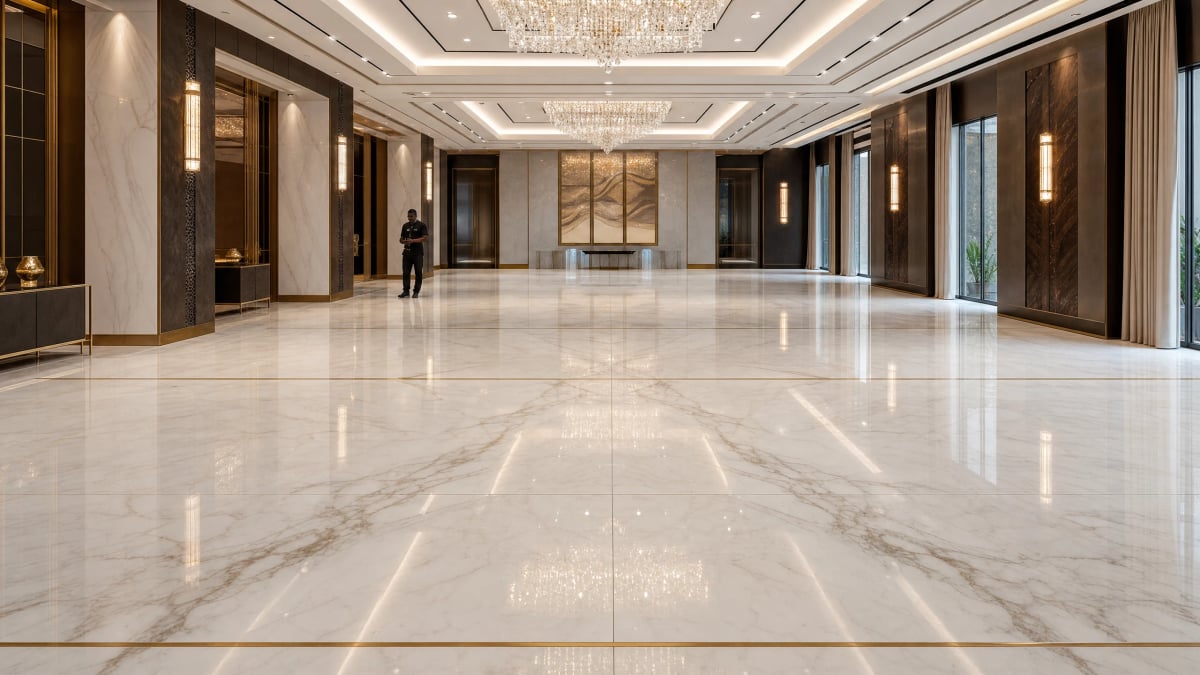
Tilers Ghana delivers FF35/FL25 substrate preparation, batch-matched material procurement, and specification-grade rectified-edge alignment for ≥600×600 mm large-format porcelain across hotel ballroom, corporate atrium, and executive lobby commissions.
Tilers Ghana delivers FF35/FL25 substrate preparation, batch-matched material procurement, and specification-grade rectified-edge alignment for ≥600×600 mm large-format porcelain across hotel ballroom, corporate atrium, and executive lobby commissions.
The Challenge
Large-format porcelain — panels at 600×600 mm and beyond — imposes an unforgiving specification discipline that separates institutional-grade installation from ordinary trade work. At these dimensions, substrate flatness tolerances measured in millimetres become decisive: a floor that reads as a single coherent plane in a hotel ballroom or a corporate atrium demands FF35/FL25 flatness ratings sustained across hundreds of square metres before a single tile is committed. Where substrates fall short, lippage accumulates, grout joints telegraph movement, and the commission that appeared seamless in the design presentation reads as remedial work within eighteen months.
The procurement dimension compounds the challenge. Large-format rectified-edge porcelain is manufactured in production batches, and shade variation between batches is not a matter of perception — it is a measurable, documented phenomenon that specifiers and Tier-1 clients cannot afford to discover mid-installation. A ballroom floor drawn from two incompatible batches is a ballroom floor that must be relaid. The institutional sector — hotel groups, diplomatic premises, corporate headquarters, financial services lobbies — carries zero tolerance for that outcome.
Ghana’s construction environment adds further complexity. Import lead times, port release cycles, and in-country warehousing constraints mean that batch management must be engineered into the procurement schedule before groundbreaking, not resolved reactively on site. The tile specialist who arrives without a material strategy already in place is not operating at the specification level these commissions demand.
The Tilers Ghana Solution
Established in 1976, Tilers Ghana has spent 50 years developing the substrate-to-surface methodology that large-format porcelain specification demands. Every commission in this format class opens with a full substrate assessment against FF35/FL25 flatness criteria, followed by a remediation programme — grinding, self-levelling compound application, or structural topping as the reading dictates — before any adhesive is placed. This sequence is non-negotiable. The floor’s long-term performance is decided at the substrate stage, not at the tile stage.
Material procurement is managed under a closed-batch protocol. At engagement, the full material quantity is calculated, sourced from a single confirmed production batch, and held under documented lot control. Shade certification accompanies every pallet. Rectified-edge alignment is executed to ≤1 mm joint tolerances using calibrated fixed-spacer systems, with each row laser-checked against the datum line established at installation commencement. The result is a surface that reads as the specifier intended — continuous, authoritative, and built to institutional life-cycle standards.
Material + System Specification
- Substrate preparation: FF35/FL25 flatness assessment and remediation using polymer-modified self-levelling compounds rated to full live-load specification
- Adhesive system: Large-format rapid-set, non-slump adhesive mortar with full-bed coverage confirmation to ≥95% back-coat contact
- Tile format: Rectified-edge porcelain ≥600×600 mm, up to 1200×2400 mm slab formats on confirmed structural substrates
- Batch management: Single-batch procurement with shade-lot documentation and bonded warehousing through installation completion
- Joint control: Calibrated fixed-spacer alignment to ≤1 mm tolerance; epoxy or cementitious grout selection specified by exposure class
- Quality gate: Post-lay hollow-sound survey across 100% of installed area; non-conforming tiles replaced before grout stage
Typical Project Profile
A representative commission engages Tilers Ghana at design-development stage for an institutional lobby, hotel ballroom, or corporate atrium ranging from 400 m² to 3,000 m² of large-format porcelain floor and wall cladding. Procurement is contracted 14–20 weeks ahead of installation to secure batch integrity. On-site installation programmes typically run 6–14 weeks depending on floor area and sequencing with other trades, with substrate preparation and curing periods built into the critical path before tile placement begins.
Outcomes
- Substrate delivered to FF35/FL25 flatness prior to tile placement — zero remedial lippage
- Full batch continuity across the installed area, documented by shade-lot certification
- ≤1 mm rectified-edge joint alignment sustained at scale across hotel ballroom and corporate atrium commissions
- 100% hollow-sound survey approval before project handover
- Institutional-grade surface finish consistent with the original design specification, delivered on programme