
The problem
Hotel chains and multi-property developer portfolios face the cost and coordination drag of contracting different tile installers across each property.
Our approach
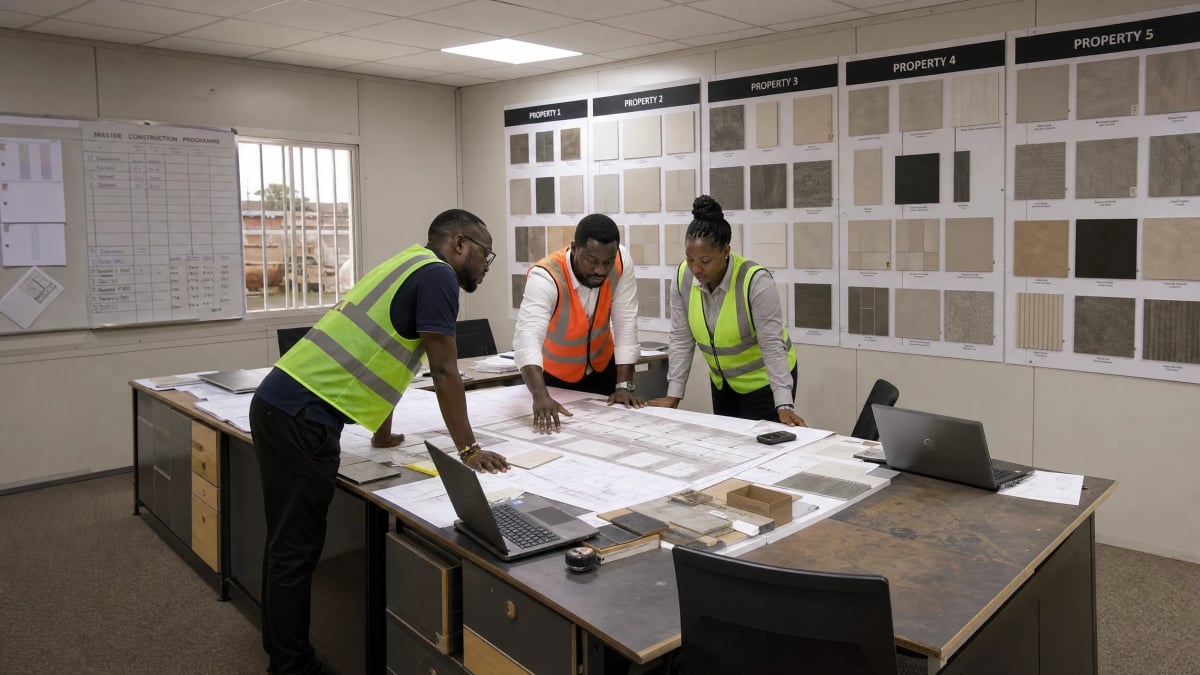
Tilers Ghana operates a multi-property project office model — single specification document, single QC regime, single warranty schedule — across 3-15 property rollouts in hospitality, residential developer, and corporate-fit-out chains.
Tilers Ghana operates a multi-property project office model — single specification document, single QC regime, single warranty schedule — across 3-15 property rollouts in hospitality, residential developer, and corporate-fit-out chains.
The Challenge
When a hospitality group commissions five serviced apartments across three districts, or a residential developer launches a twelve-unit townhouse chain on a single masterplan, the tile specification problem multiplies. Each property must read as one coherent development — same grout line depth, same lippage tolerance, same surface finish — yet site conditions vary, procurement windows compress, and subcontractor quality fluctuates without a disciplined oversight structure in place.
Ghana’s construction sector has historically handled multi-property rollouts through fragmented site-by-site procurement, where each property manager sources independently and QC is informal. The result is visible: variation in tile alignment, inconsistent grout colour drift across units, and warranty disputes that surface only after handover. For a developer whose brand promise rests on a premium finish delivered consistently from Unit 1 to Unit 15, that fragmentation carries real commercial risk.
The institutional client — whether a hospitality brand, a corporate occupier fitting out regional offices, or a residential developer delivering to discerning buyers — requires a single specification document that travels unchanged from the first property to the last, held by a tile office capable of enforcing it.
The Tilers Ghana Solution
Tilers Ghana operates a dedicated Multi-Property Project Office model. At contract award, a single specification document is drafted — covering substrate preparation standards, adhesive and grout systems, tile orientation and layout plans, lippage tolerances, and warranty schedule — and that document governs every property in the chain without deviation. A resident specification lead is assigned to the programme, not to individual sites, ensuring cross-property consistency is managed at source rather than audited after the fact.
Site-level teams are inducted against the specification document before mobilisation, and QC inspections are conducted on a rolling schedule — each property benchmarked against the first completed unit, which functions as the programme’s live reference installation. Materials are procured centrally against a consolidated bill of quantities, eliminating the substitution risk that arises when individual site managers source locally under time pressure.
This model has been refined across 50 years of institutional tile practice in Ghana. It is the structure that allows a twelve-property hospitality rollout to complete to a single finish standard, accepted by a single client sign-off, covered by a single warranty schedule.
Material + System Specification
- Substrate regime: Cement board or screed-levelled RC slab preparation to ±3mm flatness tolerance across all properties
- Adhesive system: Polymer-modified, large-format tile adhesive rated for Ghana’s humidity and temperature cycling — consistently applied across the programme
- Tile range: Specification-grade porcelain, natural stone, and technical tile formats sourced from approved-supplier lists maintained per programme
- Grout system: Epoxy or cementitious grout specified by zone — wet areas, circulation zones, and exterior terraces receive zone-appropriate formulations, uniformly applied
- Lippage control: Levelling clip systems deployed across all large-format installations, with lippage tolerance held to ≤1.5mm per programme standard
- Warranty schedule: Single consolidated warranty document covering materials and workmanship across all properties, issued at programme completion
Typical Project Profile
A typical multi-property engagement runs between 3 and 15 properties, spanning 6 to 24 months of phased installation. Sectors served include serviced apartment chains, townhouse developer rollouts, corporate office fit-out chains, and boutique hospitality groups. Tiled areas per property typically range from 400m² to 2,400m², with programme totals regularly exceeding 10,000m² of specification-grade installation across a single contract.
Outcomes
- Finish consistency: Every property in the chain meets the same lippage, grout, and alignment standard — verified against the reference installation
- Procurement efficiency: Centralised material procurement eliminates substitution risk and reduces per-unit cost variance across the programme
- Single accountability: One specification document, one QC regime, one warranty schedule — one point of contact for the client from mobilisation to handover
- Reduced defect exposure: Rolling QC inspections and specification-led induction reduce post-handover defect notifications materially across the programme
- Institutional credibility: A tile finish delivered consistently across multiple properties supports the developer’s own brand positioning with end buyers and operators