
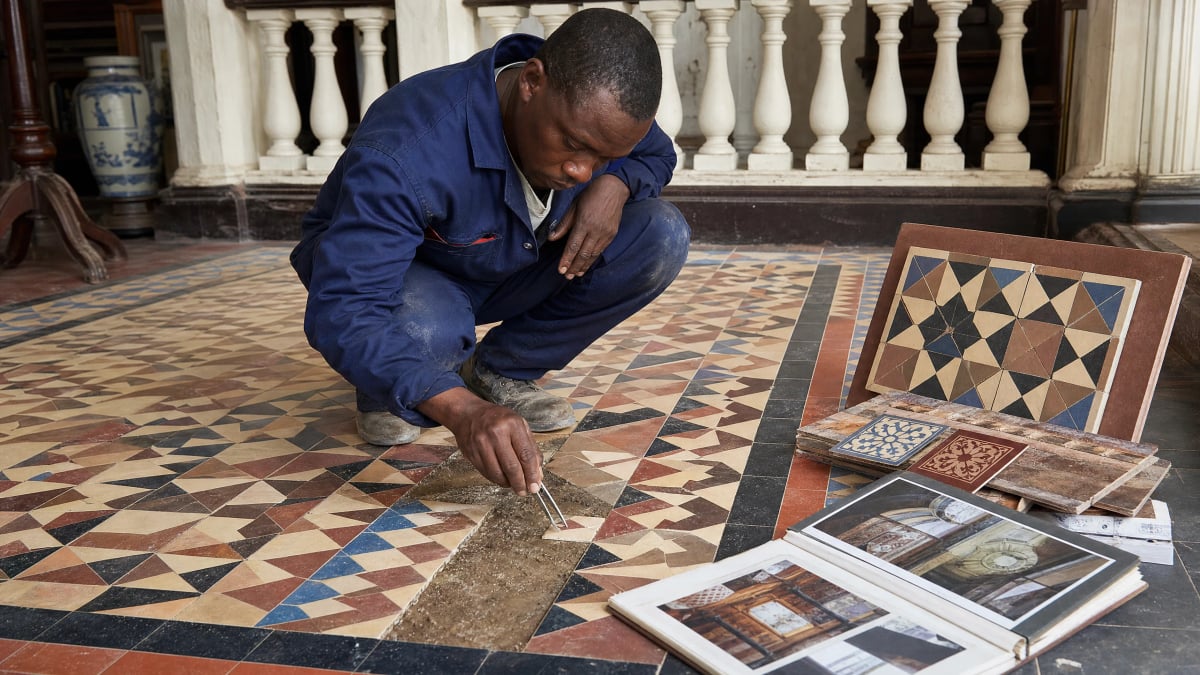
The problem
Original colonial-era encaustic, Victorian geometric, and mid-century mosaic installations require period-authentic restoration that contemporary replacement cannot reproduce.
Our approach
Tilers Ghana provides forensic survey, period-matched replacement piece commissioning, and conservation-grade re-laying for heritage tile commissions in embassies, ministerial residences, and protected cultural buildings.
Tilers Ghana provides forensic survey, period-matched replacement piece commissioning, and conservation-grade re-laying for heritage tile commissions in embassies, ministerial residences, and protected cultural buildings.
The Challenge
Heritage tile installations — period mosaic floors in diplomatic residences, ministerial halls, and gazette-listed cultural buildings — occupy a category of commission where standard replacement methodology is categorically inadequate. These surfaces carry architectural intention encoded in pigment, format, and laying pattern; damage or inappropriate intervention erases irreplaceable institutional memory. In Ghana’s equatorial climate, decades of thermal cycling, sub-base movement, and groundwater ingress compound the challenge, loosening individual tesserae, lifting entire field sections, and introducing hairline fracture networks that migrate invisibly beneath the surface before they manifest as visible loss.
The procurement problem is equally exacting. Period encaustic tiles, hand-cut marble mosaic, and early-twentieth-century hydraulic cement formats are no longer in commercial production at scale. A standard tiling contractor sourcing from contemporary distributor stock will introduce colour-batch discontinuity, dimensional mismatch, and surface texture variance that is immediately legible to the trained eye — and permanently damaging to the visual coherence of a protected interior. Embassies, heritage agencies, and state protocol departments have learned, often at considerable remediation cost, that heritage tile work demands forensic rigour before a single tile is touched.
The Tilers Ghana Solution
Tilers Ghana has delivered heritage mosaic restoration commissions since the early years of the practice, accumulating 50 years of institutional memory across diplomatic, ministerial, and cultural building typologies. The methodology begins not with installation but with forensic survey: a systematic tile-by-tile condition mapping that documents loss, delamination, staining, and sub-base compromise before any intervention is specified. This survey data drives a precision scope of works, eliminating both under-specification — where latent damage is left to progress — and over-intervention, which unnecessarily disturbs stable historic fabric.
Where replacement tiles are required, Tilers Ghana engages specialist period-matching commissioning: sourcing from European conservation-grade manufacturers, matching pigment lot against archived reference samples, and verifying dimensional tolerance to within 0.5 mm of the original format. Re-laying follows conservation-grade protocol — flexible hydraulic lime bedding compounds, reversible fixing systems, and period-sympathetic jointing mortars that allow future conservators access to the substrate without destructive removal. The result is an intervention that is technically invisible and institutionally appropriate.
Material + System Specification
- Forensic condition survey — tile-by-tile mapping with photographic record, delamination sounding, and sub-base moisture assessment prior to scope definition
- Period-matched tile commissioning — conservation-grade sourcing from European specialist manufacturers; pigment-lot verification and dimensional tolerance control to ±0.5 mm
- Flexible hydraulic lime bedding — breathable, reversible bedding compound compatible with historic sub-bases; prevents future moisture-trap failure
- Conservation jointing mortars — period-sympathetic coloured grout formulations matched to original joint profile and finish
- Reversible fixing systems — intervention designed for future conservator access; no permanent epoxy adhesion to historic substrate
- Documentary completion record — photographic archive, material specification sheet, and condition baseline supplied to the commissioning institution on project close
Typical Project Profile
Heritage mosaic restoration commissions typically engage Tilers Ghana for 6 to 18 weeks, depending on floor area and the complexity of the period-matching requirement. Sectors served include diplomatic residences and chancery reception halls, protected ministerial buildings, gazette-listed cultural institutions, and premium hospitality properties with period-significant interiors. Project scope ranges from localised loss repair covering individual panels to full floor restoration across grand entrance halls and formal reception suites — each commission preceded by a formal condition survey and specification document issued for client review before works commence.
Outcomes
- Period authenticity preserved — colour, texture, and laying pattern continuity maintained to conservation standard, indistinguishable from undisturbed original fabric
- Sub-base pathology resolved — moisture ingress, delamination, and structural movement addressed at root cause, not cosmetically treated
- Institutional record protected — documentary archive supplied on completion, supporting future heritage agency inspection and ongoing stewardship
- Compliance-grade delivery — methodology aligned with international conservation standards, satisfying heritage agency, diplomatic mission, and state protocol requirements
- Long-term stability assured — reversible fixing and breathable bedding systems extend the functional life of the restored surface without locking out future intervention