
The problem
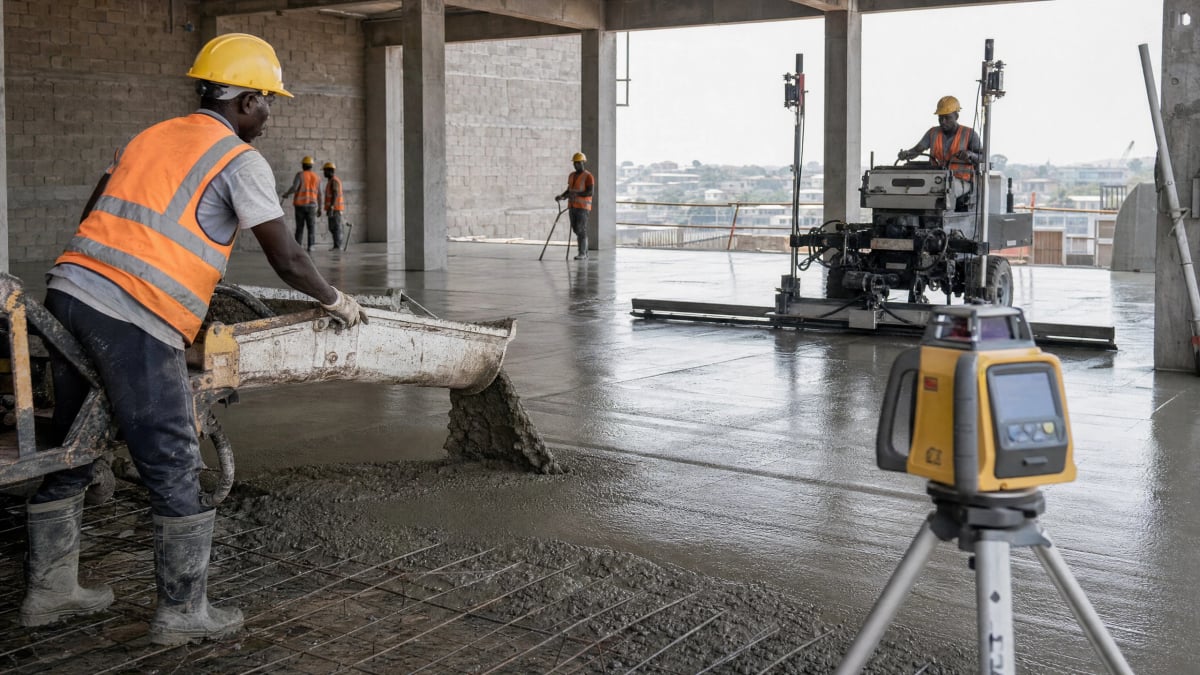
Existing substrates across Ghanaian institutional buildings frequently fall outside the moisture, levelness, and surface-profile specifications that large-format and natural-stone installations require.
Our approach
Tilers Ghana provides specification-grade substrate engineering — moisture suppression, self-levelling compound, ICRI CSP grinding — as a standalone commission or as preparatory phase for downstream tile installation.
Tilers Ghana provides specification-grade substrate engineering — moisture suppression, self-levelling compound, ICRI CSP grinding — as a standalone commission or as preparatory phase for downstream tile installation.
The Challenge
Beneath every specification-grade tile installation lies a substrate — and the substrate is where institutional projects succeed or fail. In Ghana’s built environment, rapid construction schedules frequently compress curing windows, leaving concrete slabs that retain residual moisture well above the thresholds that tile adhesive systems can tolerate. The consequence is predictable: delamination, hollow-bed failures, grout cracking, and costly remediation within 18 to 36 months of handover. For a Tier-1 bank headquarters lobby or a pharmaceutical manufacturing facility, that timeline is unacceptable.
The sector compounds the problem. Commercial and industrial clients operating in Accra CBD, Airport City, Tema Industrial, and Cantonments expect their finished environments to perform without intervention for 15 to 25 years. That expectation cannot be met with adhesive alone. It is met — or broken — at the substrate preparation stage, long before the first tile reaches the floor.
Substrate engineering is therefore not a preliminary task to be delegated to the lowest-cost subcontractor. It is a precision discipline requiring moisture measurement, surface profile classification to ICRI standards, and the correct selection of suppression and levelling systems for the specific slab chemistry, ambient humidity, and downstream tile specification. Tilers Ghana commissions this work as both a standalone service and as the preparatory phase anchoring its full installation programmes.
The Tilers Ghana Solution
Tilers Ghana’s substrate engineering practice opens with a structured diagnostic protocol. Moisture readings are taken using calibrated relative-humidity probes at multiple slab depths — not surface-only readings, which routinely understate vapour drive. The slab surface profile is classified against ICRI Concrete Surface Profile (CSP) standards, establishing the mechanical key required for the adhesive system specified downstream. Only when the diagnostic data is complete does the specification proceed.
Where moisture suppression is indicated, the practice deploys epoxy-based moisture control membranes rated to suppress vapour emissions at or above 25 kg/m²/24 hours — a threshold that covers the majority of freshly poured or inadequately cured slabs encountered on institutional project sites in Ghana. Self-levelling compound is applied where surface deviation exceeds tolerance for the tile format specified: large-format porcelain and natural stone installations demand substrate flatness within 3 mm over 3 m. The compound is selected by compressive strength grade, drying time window, and compatibility with the adhesive system.
The result is a substrate that is measurably flat, moisture-controlled, and mechanically keyed — a surface that the tile installation phase can receive with confidence.
Material + System Specification
- Moisture suppression membranes — epoxy-chemistry systems rated for high-vapour-drive substrates, applied to ICRI CSP 3–5 profiles
- Self-levelling compound — polymer-modified, compressive strength ≥ 20 N/mm², applied to correct deviations for large-format tile installation
- ICRI CSP grinding and shot-blasting — mechanical surface preparation to achieve the correct profile for bonded overlay systems
- Calibrated RH probe moisture testing — multi-depth slab readings to ASTM F2170 protocol, documented and recorded for project QA files
- Crack isolation membranes — uncoupling-layer systems applied over shrinkage cracks and construction joints to prevent reflective cracking at tile face
- Priming systems — penetrating and surface-applied primers matched to slab porosity and self-levelling compound adhesion requirements
Typical Project Profile
Substrate engineering commissions typically range from 200 m² to 4,500 m² of prepared surface area, spanning timeframes of 3 to 14 working days depending on slab extent, moisture suppression cure windows, and sequencing with downstream trades. Sectors served include Tier-1 banking and financial services lobbies, diplomatic and government facilities, premium hospitality environments, pharmaceutical and food-grade manufacturing plants, and multinational regional headquarters. The service is commissioned as a standalone scope — delivered to a contractor’s or client’s own tile installation programme — or as Phase 1 of Tilers Ghana’s integrated installation mandate.
Outcomes
- Substrate delivered at or below the moisture threshold specified for the tile adhesive system, with calibrated test documentation
- Surface flatness within 3 mm over 3 m, suitable for large-format porcelain and natural stone installation
- Elimination of delamination and hollow-bed failure risk attributable to substrate condition
- Full QA documentation package — moisture readings, CSP classification, product data sheets, application records — issued at phase completion
- A foundation that allows the tile installation phase to proceed on programme, without remediation delay