
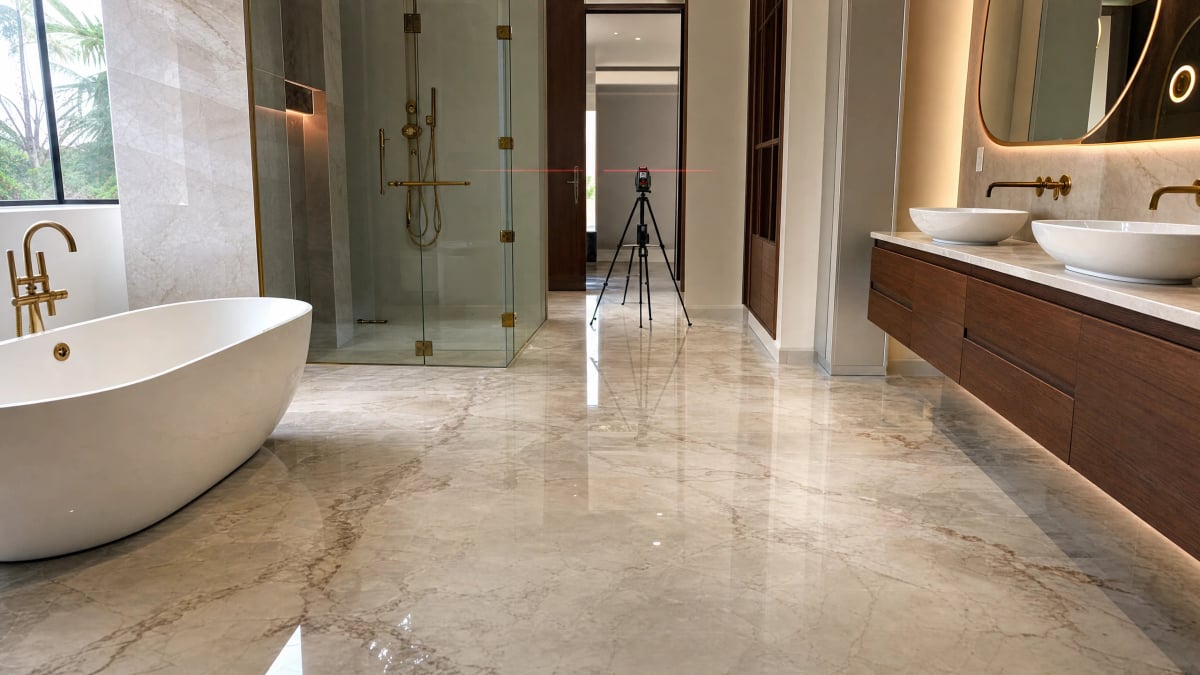
The problem
Premium bathroom commissions in financial-grade, Tier-1 corporate, and luxury residential clients require flatness specification beyond ordinary tile-contractor workflow.
Our approach
Tilers Ghana measures and documents FF/FL F-numbers per ASTM E1155 across every premium bathroom installation, ensuring shower-area drainage falls and large-format floor flatness meet Tier-1 institutional standard.
Tilers Ghana measures and documents FF/FL F-numbers per ASTM E1155 across every premium bathroom installation, ensuring shower-area drainage falls and large-format floor flatness meet Tier-1 institutional standard.
The Challenge
In premium bathroom installations, floor flatness is not a cosmetic consideration — it is a structural and functional imperative. Large-format porcelain and stone tiles demand substrate planes that meet exacting tolerances; any deviation beyond specification produces lippage, cracked grout joints, and — in wet zones — pooling water that defeats drainage design entirely. These are not minor inconveniences. In a Tier-1 hotel suite, a diplomatic residence, or a private banking facility, a standing puddle on a shower floor represents a failure of the installation at its most fundamental level.
Ghana’s construction sector has historically treated floor flatness as a visual judgement call — a site foreman’s eye rather than a measured, documented standard. The consequence is a widespread gap between specified intent and delivered reality, particularly as large-format tiles (600×600mm, 800×800mm, and beyond) have become the institutional default. These formats amplify substrate imperfections that smaller tiles would absorb. Without formal FF/FL measurement per ASTM E1155, there is no objective record that the floor was ever within tolerance — and no accountability when it is not.
The challenge compounds in shower areas, where drainage fall requirements must coexist with the flatness demands of large-format field tiles. A gradient too shallow produces ponding; a substrate too irregular prevents consistent tile bedding and increases the risk of debonding over time. Managing both parameters simultaneously, on live construction programmes with compressed timelines, requires methodology — not intuition.
The Tilers Ghana Solution
Tilers Ghana applies ASTM E1155 FF/FL F-number measurement as a standard protocol across every premium bathroom installation, not as an optional quality check but as a non-negotiable pre-installation and post-screed verification step. Before a single tile is bedded, the substrate is surveyed with calibrated floor profilers, and F-number readings are documented against project-specific tolerances agreed with the principal contractor or client representative. Where readings fall outside specification, the screed is corrected — full stop.
In shower and wet-zone areas, the practice extends to precise drainage fall verification. Tilers Ghana’s installation methodology incorporates pre-formed shower tray formers or hand-screeded falls with documented gradient measurements, ensuring that drainage design is executed to millimetre accuracy rather than approximated. Large-format tiles in wet zones are bedded using full-coverage polymer-modified adhesives and back-buttered, eliminating voids that would otherwise allow tile flex and long-term debonding.
The documentation produced at each stage — FF readings, FL readings, drainage fall gradients, adhesive coverage certificates — forms a permanent project record that Tier-1 clients and their quantity surveyors can retain as evidence of specification compliance.
Material + System Specification
- Substrate measurement via calibrated floor profiler to ASTM E1155, with FF and FL readings documented on dimensioned floor plan
- Pre-formed linear-drain and point-drain shower tray formers rated for large-format tile (minimum 600×600mm field tile compatibility)
- Polymer-modified tile adhesive (C2TE S1 or S2 classification, EN 12004) applied by notched trowel with full back-buttering on tiles exceeding 900cm²
- Large-format porcelain or natural stone tiles sourced to specification-grade dimensional tolerances (≤0.5% bow per EN 14411)
- Epoxy or cement-based grout selected per joint width, chemical resistance requirement, and client-specified colour standard
- Written compliance record delivered at practical completion: FF/FL readings, drainage fall measurements, adhesive lot numbers, tile batch references
Typical Project Profile
A typical engagement covers 4 to 40 wet rooms across a single project — premium hotel room blocks, executive apartment developments, diplomatic residences, or Tier-1 corporate wellness suites. Programme durations range from three weeks for boutique residential commissions to twelve weeks for full hotel-floor packages. Sectors served include premium hospitality, private residential at developer and owner-occupier level, healthcare facilities requiring slip-rated wet-zone floors, and institutional office fit-outs incorporating executive bathroom suites.
Outcomes
- Substrate delivered and documented within ASTM E1155 FF/FL tolerances prior to tile installation commencing
- Drainage falls verified to gradient specification, eliminating standing water in shower and wet zones
- Full-coverage adhesive bedding confirmed, reducing long-term debonding and lippage risk on large-format tiles
- Permanent compliance record provided to client and principal contractor for project close-out documentation
- Finished surfaces meeting Tier-1 institutional standard — the benchmark Tilers Ghana has maintained since 1976